P2P Networking
What Is a P2P Network?
A peer-to-peer network (P2P) is a decentralized internet architecture that relies on a group of users (peers) to exchange information. Its purpose is to reduce the intermediate nodes in traditional network transmissions, thereby lowering the risk of data loss. Unlike centralized network systems with a central server, each client in a peer-to-peer network is both a node and functions as a server. No single node can directly find other nodes -- they must rely on the peer group for information exchange.
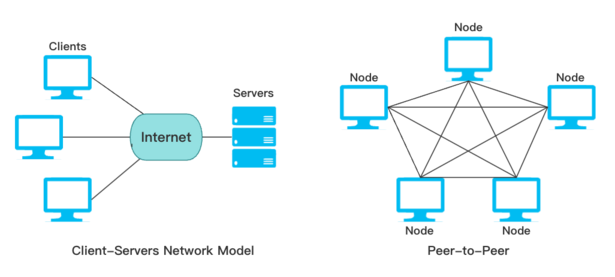
Advantages of P2P Networks
- Decentralization: Resources and services in the network are distributed across all nodes. Information transmission and service delivery occur directly between nodes without the need for intermediaries or servers, avoiding potential bottlenecks.
- Security: The modern internet is highly centralized, with most communications going through central servers. Central servers aggregate everyone's information, making them the most attractive targets for attackers. Once a server is compromised, the information security of all users is lost. P2P offers a more secure alternative, especially after implementing end-to-end encryption.
- Performance: In most of today's internet, two users need to communicate through intermediate servers. When the number of users increases, this can cause server congestion or even crashes. P2P networks have no such central server -- they enable direct connections between users for point-to-point transmission, thereby improving network performance.
- Greater Privacy: Under the P2P architecture, since there is no central server, there is no company playing a central role. Thus, under P2P architecture, we build trustless systems. Users control their own privacy and do not need to trust that a company will not leak their data -- they only need to trust the mathematical principles of the communication protocol.
P2P Network Applications in Blockchain
P2P technology is widely applied in many fields such as file sharing, computing power and storage sharing, instant messaging, and more. All blockchains are P2P networks, such as Bitcoin and Ethereum.
The P2P (peer-to-peer) network of a blockchain refers to the direct connection and information exchange between nodes in the blockchain network without the intermediation of a central server. This ensures the distributed nature, security, and fault tolerance of the network. Here are some common concepts encountered in blockchain P2P networks:
1. Nodes:
Nodes in a blockchain P2P network are computers or devices connected to the network. Each node can be a participant in the blockchain network. Nodes can be miners, validators, regular users, etc.
2. Connections:
Each node establishes connections with other nodes to form a network. These connections can be bidirectional, allowing information to be passed between nodes.
3. Information Propagation:
In a blockchain P2P network, nodes propagate new transaction and block information through their connections. When a node produces a new transaction or block, it broadcasts this information to other nodes it is connected to, allowing the information to spread throughout the entire network.
4. Broadcasting and Diffusion:
Information broadcasting between nodes is typically achieved through message passing. A node sends information to other nodes, and those nodes continue passing the information to more nodes, achieving rapid information diffusion.
5. Synchronization:
Nodes in a P2P network need to maintain blockchain data synchronization. When a new block is added to the blockchain, all nodes need to update their copy of the blockchain to maintain consistency.
6. Consensus Algorithms:
P2P networks play a key role in the consensus process, where nodes need to reach agreement on the validity of transactions and blocks. Consensus algorithms ensure data consistency across all nodes in the network while preventing attacks from malicious nodes.
7. Fault Tolerance:
Blockchain P2P networks have strong fault tolerance -- even if some nodes in the network fail or are attacked, other nodes can continue to operate and propagate data.
8. Privacy and Security:
Blockchain P2P networks allow nodes to communicate directly, but data privacy and security must also be protected. Encryption technology, digital signatures, and other methods ensure the confidentiality and integrity of data transmitted across the network.
9. Fork Handling:
In summary, the blockchain P2P network enables nodes to interact directly, building a decentralized, distributed network structure that achieves data sharing, exchange, and consensus -- one of the core foundations of blockchain technology.