Merkle Trees
What Is a Merkle Tree?
A Merkle tree, also known as a hash tree, is a tree-based data structure widely used in blockchain and other distributed systems. It encodes and verifies data through hash functions to ensure data integrity and consistency.
Core Characteristics
-
Structure
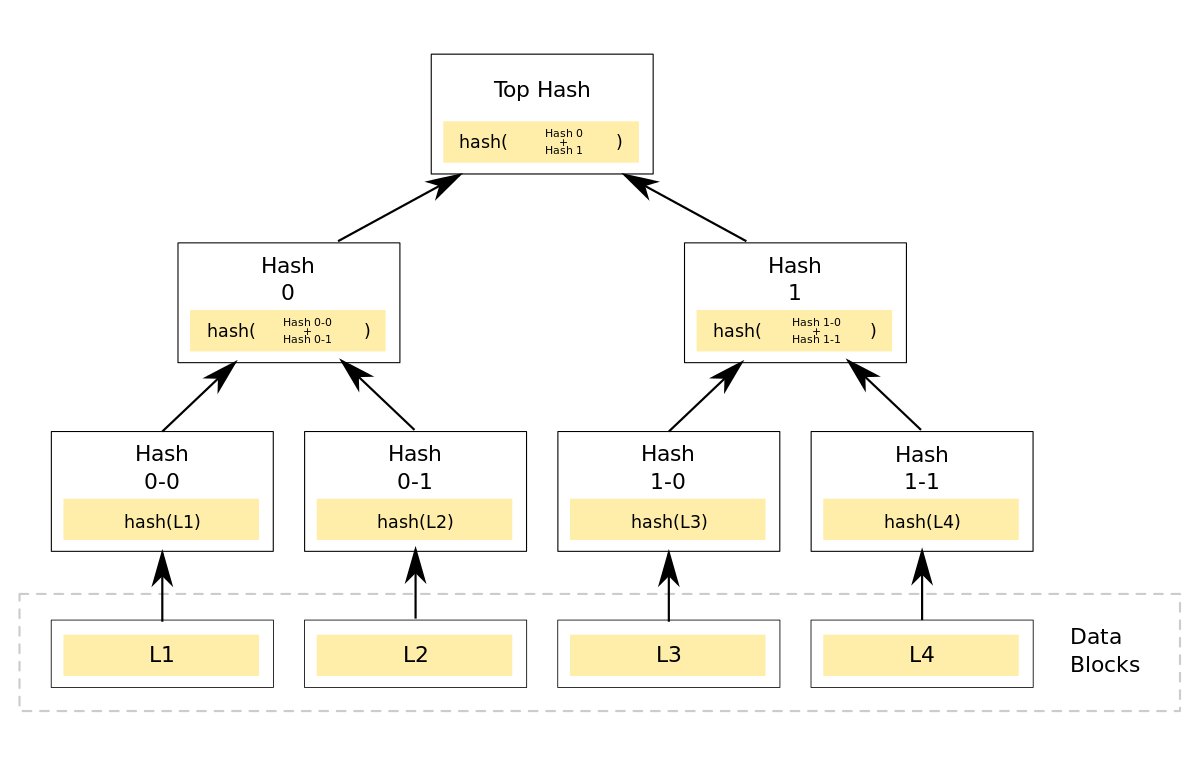
A Merkle tree is a binary tree in which leaf nodes store the hash values of original data, and non-leaf nodes store the hash of their child nodes' hash values. Ultimately, the root node (called the Merkle root or root hash) consolidates the hash values of all leaf nodes.
-
Construction Process
The process of building a Merkle tree can be simplified into the following steps:
- Leaf nodes: Perform a hash operation on each data block to generate leaf nodes.
- Intermediate nodes: Hash the hash values of two leaf nodes together to generate the hash value of their parent node.
- Root node: Repeat this process until the top-level root node hash value is generated.
-
Verifying Data Integrity
Merkle trees can efficiently verify the integrity of portions of data. For example:
When you need to verify whether a specific data block is included in a Merkle tree, you only need to compute the hash value of that data block, then recursively verify the parent node hash values along the corresponding path up to the root node, thereby confirming that the data block is part of the tree.
-
Advantages
- Efficiency: Merkle trees can verify whether a data block is in the dataset in \(O(log(n))\) time complexity.
- Security: Multi-level hash operations ensure data cannot be tampered with.
- Bandwidth savings: There is no need to transmit the entire dataset -- only the relevant hash path needs to be transmitted to verify the authenticity of a data block.
Example
Consider a simple example with 4 data blocks: D1, D2, D3, D4. The Merkle tree construction process is as follows:
- Compute the hash value of each data block:
- Generate intermediate nodes:
- Generate the root node:
The resulting Merkle root H1234 represents the hash of the entire dataset. This makes verifying the integrity of any individual data block efficient and reliable.
In summary, through its unique hash structure, the Merkle tree provides an efficient and secure method for data verification and transmission in distributed systems.