DApp
Decentralized Application - DApp (Decentralized Application)
A decentralized application is an application that runs on a distributed network rather than relying on a single central server. Typically, a DApp's core logic is handled by smart contracts on the blockchain. Ideally, the DApp's frontend is also hosted on a decentralized storage network.
The DApp frontend interface needs to integrate a wallet (or connect with a wallet). When a user needs to invoke a contract function, the user's wallet provides the signature for the function call, ensuring that users truly control their own data ownership.
Below is a simple DApp architecture diagram:
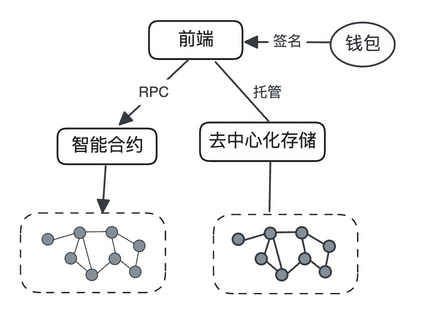
More complex DApps also need to obtain off-chain data through oracles.
Some DApps also provide their own backend services, but these are typically used for caching on-chain data to enable faster user access.
Key Characteristics of DApps:
- Decentralization: Unlike traditional applications that rely on centralized servers, DApps run on decentralized networks, ensuring there is no single point of failure and reducing the risk of censorship.
- Open Source: DApp source code is typically open for anyone to inspect, verify, and contribute to, fostering trust and collaboration within the community.
- Blockchain Integration: DApps typically interact with smart contracts on the blockchain. Smart contracts are self-executing contracts where the terms of the agreement are written directly into code, facilitating trustless and automated transactions.
- Tokenization: Many DApps use cryptocurrency or tokens as a means of value transfer within the application. These tokens can serve various purposes such as governance, service access, or user rewards.
- Immutability: Data on the blockchain is immutable -- once a transaction or data is recorded, it cannot be altered or deleted. This ensures data integrity and transparency.
Common Application Areas
Due to DApps' advantages of decentralization, censorship resistance, transparency, security, and global accessibility, they demonstrate tremendous potential and development prospects:
- Decentralized Finance (DeFi): Includes decentralized exchanges (DEX), lending platforms, stablecoins, derivatives trading, and more. DeFi DApps provide financial services through smart contracts, eliminating dependence on traditional financial intermediaries. Examples include Uniswap, Aave, and Compound.
- Gaming and Entertainment: Decentralized games and virtual worlds (such as Decentraland) allow players to own and trade in-game assets (such as NFTs) and participate in decentralized game governance. For example, Axie Infinity.
- Social Media: Decentralized social platforms aim to give users control over their data and content, such as friend.tech and Mastodon.
- Decentralized Autonomous Organizations (DAOs): DAOs are organizations run through smart contracts, where members can vote using tokens to make decisions about the organization's operations and development.
- Digital Identity and Authentication: Leveraging blockchain's immutability and transparency, DApps can be used to manage and verify digital identities, providing decentralized identity authentication services.
- Supply Chain Management: By recording product manufacturing, shipping, and sales processes on the blockchain, DApps can provide more transparent and traceable supply chain management systems, such as VeChain.
- Content Copyright and Distribution: Creators can publish and sell content directly through DApps, ensuring copyright protection and receiving revenue directly.
DApps face some challenges in achieving mass adoption. The user experience of DApps is typically not as smooth as traditional applications, mainly because wallet interaction is not convenient enough and blockchain transaction wait times are long. Some applications also face legal and regulatory challenges.
However, with technological advancement and the maturation of legal frameworks, DApps are expected to gain widespread adoption and adoption across more domains.