Blockchain
What Is Blockchain?
Blockchain originated from Bitcoin. On November 1, 2008, a person using the pseudonym Satoshi Nakamoto published the paper "Bitcoin: A Peer-to-Peer Electronic Cash System," which outlined the architecture of an electronic cash system based on P2P networking technology, cryptography, timestamp technology, and blockchain technology. This marked the birth of Bitcoin. On January 9, 2009, block number 1 appeared and was connected to block number 0 (the genesis block), forming a chain -- this marked the birth of blockchain.
A blockchain is a chain composed of blocks linked one after another. Each block contains a set of transaction data and is linked to the previous block through a hash (as shown below). This chain is stored across all nodes in a distributed network (a node can be thought of as a server). As long as at least one node in the entire system is operational, the blockchain data remains secure. Nodes in the blockchain system provide storage space and computational power for the entire network.
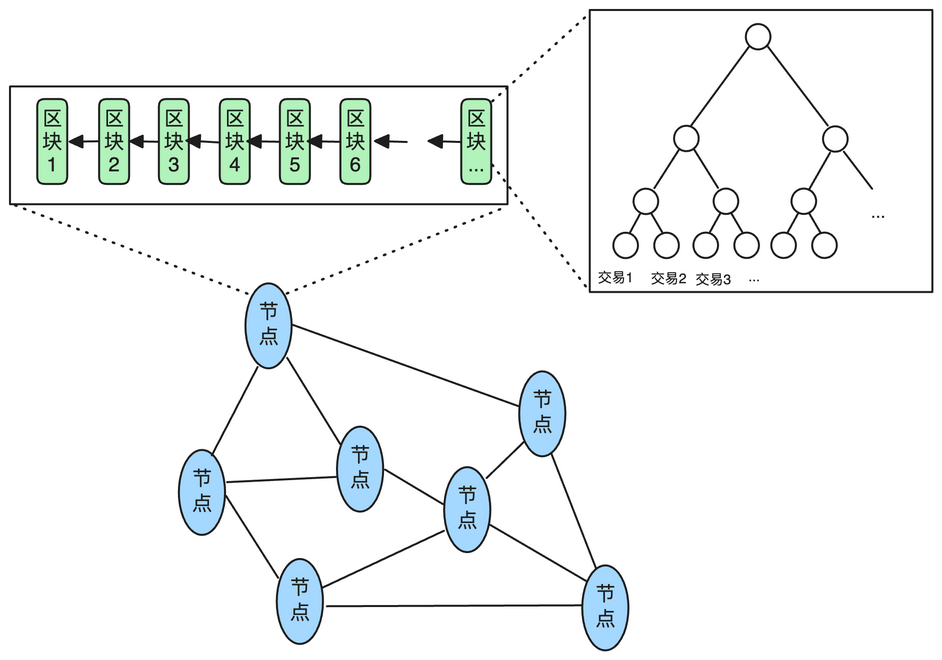
To modify information on the blockchain, one would need the agreement of more than half of the nodes and would have to alter the information on all nodes. Since these nodes are typically controlled by different entities, tampering with blockchain data is extremely difficult.
Compared to traditional networks, the core characteristics of blockchain are: first, data is tamper-resistant, and second, it is decentralized. Based on these two characteristics, the information recorded on a blockchain is more authentic and reliable, helping to solve the problem of mutual distrust between parties.
How Does Blockchain Work?
A blockchain can be understood as a distributed database with computational capabilities. By analogy with traditional databases, it operates through several steps: a user initiates a data modification request (corresponding to creating a transaction on the blockchain), the server validates the request (corresponding to transaction verification), data is written to the database (corresponding to packaging transactions into a block), and the data is synchronized to other servers (corresponding to block broadcasting). Each step is described below:
1. Creating a Transaction: A user creates a transaction containing the recipient, sender, and transaction amount (sometimes including on-chain code to be executed). The user signs the transaction information (typically using a wallet), then sends the transaction and signature to a connected node.
2. Transaction Verification: The node verifies the legitimacy of the transaction, ensuring the sender has sufficient balance and that there is no double-spending problem (i.e., the same funds cannot be spent twice). Transactions that pass verification are broadcast by the node to other nodes in the network.
3. Packaging Transactions into a Block: Nodes package a batch of verified transactions into a block. The block contains a set of transaction records, the hash of the previous block, and a timestamp. Since block packaging comes with rewards, multiple nodes compete to produce blocks. A consensus mechanism algorithm determines whose packaged block is valid and extends the blockchain.
Consensus Mechanism: This solves the problem of how distributed nodes reach agreement. Each blockchain platform has an algorithm protocol that all nodes follow -- this is the consensus mechanism. Common consensus mechanisms include PoW (Proof of Work) used by Bitcoin and PoS (Proof of Stake) used by Ethereum.
Proof of Work (PoW): Miner nodes compete for the right to add a block by solving complex mathematical problems. The node that solves the problem fastest adds the block to the blockchain and receives a Bitcoin reward.
Proof of Stake (PoS): PoS has many variants. In PoS, staking a certain amount of tokens qualifies one as a validator. The network uses a randomized algorithm to select a validator to produce the next block.
4. Block Broadcasting: The node broadcasts the newly added block to other nodes in the network. Other nodes verify the block's legitimacy and extend their own copy of the blockchain. Since each node maintains a complete copy of the blockchain, data distribution and decentralization are ensured.
Why Is Blockchain Technology So Important?
Current internet technology has brought us tremendous convenience and efficiency improvements, but it also has some significant problems:
Centralized Control: Most internet services are controlled by a few large technology companies. These companies hold vast amounts of user data and resources, yet they create data silos. This data often does not provide greater convenience to users and may even be exploited as a tool for "precision recommendations" or targeted exploitation of users.
Privacy and Data Security Issues: The storage and processing of this information by centralized tech companies is not transparent. This leads to frequent data breaches and privacy violations, making it difficult to safeguard users' personal privacy.
High Intermediary Costs: In current internet business models, many transactions and services require intermediaries, adding cost and complexity. For example, online payments and cross-border remittances incur high fees.
Lack of Transparency: Although the internet promotes information dissemination, the source and authenticity of information are often difficult to verify. Fake news and misinformation spread easily. The lack of transparency reduces user trust in platforms and services, and platform governance and decision-making processes also lack transparency.
Content Censorship and Restrictions: Under centralized structures, companies or organizations can censor and filter information, or even manipulate and tamper with data. Content control can lead to information asymmetry, biased public perception, and hinder equality.
Blockchain Is the Solution to These Problems
- Decentralization: Blockchain reduces dependence on centralized control through its decentralized network structure, lowering the risk of single points of failure.
- Enhanced Privacy and Security: Blockchain uses cryptographic technology to protect data, allowing users to autonomously control their own data and improving privacy protection.
- Data Transparency and Immutability: Data on the blockchain is publicly transparent and, once recorded, cannot be tampered with, improving data credibility.
- Reduced Intermediary Fees: Through smart contracts and peer-to-peer transactions, blockchain can reduce intermediary fees and improve transaction efficiency.
- Improved Transparency: The transparency of blockchain makes information sources and transaction processes publicly visible, increasing user trust in the system.
- Censorship Resistance: The decentralized structure makes it difficult for any single entity to censor and control information.
By addressing the problems that exist in current internet technology, blockchain technology demonstrates revolutionary potential to provide a more secure, efficient, and fair infrastructure for the digital society of the future.