Fully Homomorphic Encryption
FHE
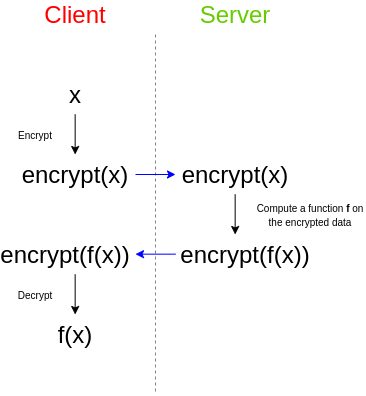
FHE (Fully Homomorphic Encryption) is a type of homomorphic encryption that enables arbitrary computations (addition, subtraction, multiplication, division) to be performed on encrypted data without first decrypting it, while still producing correct and secure results.
The core idea of FHE is to exploit the properties of mathematical structures so that encrypted data maintains "homomorphic" properties under certain operations. This means that performing certain operations between ciphertexts produces a ciphertext that, when decrypted, matches the result of performing the same operations directly on the plaintexts.
Use Cases of FHE
- Privacy-Preserving Computation: In cloud computing and big data analytics, FHE can be used to protect data privacy. For example, a company can encrypt customer data and upload it to the cloud for analysis without worrying about data leaks.
- Encrypted Search: Performing search queries on encrypted databases without decrypting the data, ensuring data privacy while providing search functionality.
- Electronic Voting: FHE can be used in electronic voting systems, allowing vote tallying to be performed on encrypted ballots, ensuring the privacy and security of the voting process.
- Financial Data Analysis: Banks and financial institutions can perform risk assessments and transaction analysis on encrypted data, protecting sensitive customer information from exposure.
- Medical Data Processing: FHE can be used to process and analyze encrypted medical data without exposing patient privacy.
FHE has enormous potential in fields with high data privacy and security requirements, though it currently faces challenges in computational overhead and efficiency.
Challenges of FHE
- Computational Overhead: Currently, the FHE computation process is very complex, involving extensive mathematical operations, resulting in high computational overhead. This makes FHE still face performance challenges in practical applications.
- Algorithm Complexity: Implementing FHE requires highly complex mathematical algorithms, and developing and deploying these algorithms requires deep specialized knowledge.
- Efficiency Issues: Although FHE provides powerful privacy protection capabilities, its computation speed and efficiency remain a significant bottleneck compared to traditional encryption.