RGB
What Is RGB?
RGB is a protocol for creating and managing digital assets on the Bitcoin network, often mentioned alongside Layer 2 concepts such as the Lightning Network.
The origins of the RGB protocol trace back to 2018, when Bitcoin community members including Giacomo Zucco, Peter Todd, and Alekos Filini began exploring a new method for creating and managing assets on the Bitcoin network. Their goal was to design a protocol that could leverage Bitcoin's security and decentralization while supporting more complex functionality (such as asset issuance and smart contracts).
To achieve this goal, they began researching how to combine asset and state information with Bitcoin's UTXO model, proposing a new protocol called RGB. The core idea is to combine asset issuance, ownership, and state updates with Bitcoin's UTXO model through client-side validation, rather than relying on Bitcoin network full nodes like BRC-20 does.
The name RGB comes from the color concept because the RGB protocol originally started as research into "colored coins." Although the current RGB protocol has little to do with colored coins, the name has been retained.
Compared to BRC-20's direct on-chain inscription system, RGB primarily adopts off-chain processing logic somewhat similar to the Lightning Network.
Implementation Principles
The implementation of the RGB protocol is not difficult to understand; the core lies in Bitcoin's own accounting method - UTXO.
RGB essentially binds off-chain asset issuance to on-chain UTXO changes: since UTXOs can confirm transaction events on Bitcoin at a specific point in time, we can map these transaction event changes to correspond to state changes of other things.
For example, if I issue an asset somewhere that corresponds to UTXO1 on the Bitcoin network, and I then transfer this asset to someone else, this "transfer" action can correspond to UTXO2 on the Bitcoin network...
Because UTXOs are inherently fixed and consensus-validated, as long as I can prove that this binding is reliable, then the UTXO changes on Bitcoin's mainnet corresponding to other asset state changes should also be accepted by consensus. Furthermore, what the RGB protocol does is leverage the security of Bitcoin mainnet UTXOs to endorse the security of its off-chain asset issuance or contract logic.
If this is hard to understand, consider the following example:
- Matt issues 100 $MATT tokens to himself on the RGB network;
- On the Bitcoin network, Matt's token issuance corresponds to his current Bitcoin UTXO A;
- Matt transfers 50 $MATT tokens to Pam;
- On the Bitcoin network, Matt's transfer corresponds to a new UTXO B, and UTXO A from step 2 is destroyed;
- On the Bitcoin network, Pam receiving tokens corresponds to a new UTXO C, representing Pam's current Bitcoin UTXO;
- Similarly, when Pam transfers tokens, her original UTXO C is also destroyed, forming a new UTXO D...
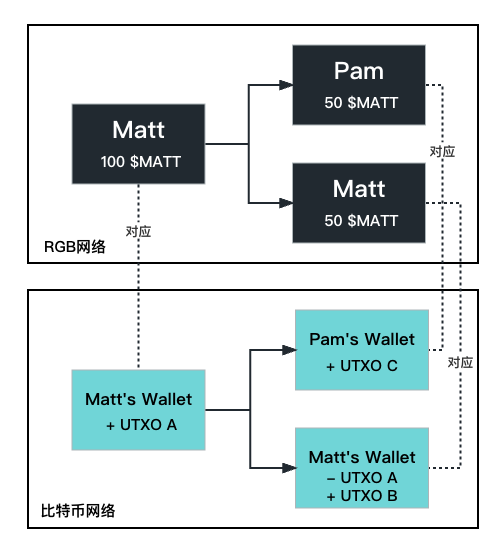
If this $MATT token keeps being transferred between different people, ultimately on Bitcoin's mainnet there will be corresponding UTXOs for these transfers as identifiers, and each transfer that occurs will cause the original UTXO to be destroyed while generating a new UTXO.
Through this process, we can see how the creation, transfer, and verification of assets in the RGB protocol are linked to Bitcoin's UTXOs. This association enables RGB assets to be transferred securely, in a decentralized manner, with privacy protection on the Bitcoin network.
Supporting Technologies
In practice, ensuring that assets issued off-chain by RGB actually correspond to on-chain UTXOs requires several other technologies.
-
Client-side Validation: In the RGB protocol, transaction verification and data storage are completed on the client side (such as wallet software), rather than on the blockchain. This means transaction data is not publicly disclosed on-chain, thereby improving privacy. Client-side validation also reduces on-chain data storage requirements, improving network scalability. This is a major difference from BRC-20 - since transaction data resides on clients rather than on-chain, it can theoretically significantly reduce current network congestion and high fee situations.
-
Single-Use-Seals: A technology that ensures asset ownership cannot be tampered with. A single-use seal is a cryptographic signature used to lock an asset's state. When an asset is transferred, the old seal is destroyed and a new seal is created. This way, any attempt to tamper with asset ownership is detectable because the seal states do not match. This corresponds to the UTXO destruction and generation described above. The old seal represents the old UTXO, and the new seal points to the new UTXO.
-
Commitments: To associate assets with the Bitcoin network, the RGB protocol uses a technology called commitments. A commitment is a cryptographic proof that a particular asset is associated with a specific Bitcoin transaction. Commitments are embedded in the outputs (UTXOs) of Bitcoin transactions, enabling assets to be transferred on the Bitcoin network.
-
Anchoring: To connect client-side validation with the Bitcoin network, the RGB protocol uses anchoring technology. Anchoring is the process of combining single-use seals and commitments. When an asset is transferred, the new single-use seal, commitment, and transaction data are anchored to the Bitcoin network, ensuring the security and consistency of the entire system.
Here is a more realistic RGB protocol workflow:
- The asset issuer creates a new asset on the client and generates a single-use seal and commitment.
- The asset issuer anchors the new asset to the Bitcoin network, embedding the commitment in the output (UTXO) of a Bitcoin transaction.
- The asset recipient verifies the asset's validity by examining the commitment and verifying the single-use seal.
- When the asset is transferred, the old single-use seal is destroyed, and the new single-use seal, commitment, and transaction data are anchored to the Bitcoin network.
Additionally, RGB integrates well with the Lightning Network. In its official documentation, RGB describes itself as an L2 or L3; when the Lightning Network is available, RGB can function as L3, enabling fast off-chain exchange of Bitcoin and RGB tokens for more efficient transactions and asset management.
Reference: https://www.panewslab.com/zh/articledetails/1bnuu827.html