Ordinals
Ordinals Protocol
NFTs are primarily minted and used on blockchains such as Ethereum, Solana, and BNB Smart Chain. However, the team behind Ordinals believed that non-fungible tokens should also have a place on the Bitcoin blockchain. This led to the creation of the Ordinals project.
The Ordinals protocol can be understood as a system for numbering satoshis (sats). By assigning each satoshi a serial number and then attaching additional data (text, images, code, etc.) - commonly referred to as "metadata" in NFT terminology - each satoshi becomes a unique NFT. This process is called "inscribing" or "engraving." According to the Ordinals protocol, satoshis are numbered based on the order in which they were mined.
Although Ordinals NFTs were truly unlocked through the conceptualization of Ordinal theory, the Ordinals NFTs that exist today were made possible by the Segregated Witness (SegWit) and Taproot updates to the Bitcoin protocol, which occurred in 2017 and 2021 respectively.
It is worth noting that these updates were not implemented for the specific purpose of enabling these new types of NFTs. However, since each update expanded the amount of arbitrary data that could be stored on-chain within a block - meaning there is now space to store images, videos, and even games - Ordinal NFTs became possible as a natural consequence.
While traditional NFTs share some similarities with Ordinals, several key differences exist. NFTs are typically created using smart contracts on blockchains like Ethereum, Solana, and BNB Smart Chain, and sometimes the assets they represent are hosted elsewhere. In contrast, Ordinals are inscribed directly onto individual satoshis and then included in blocks on the Bitcoin blockchain. Ordinals reside entirely on the blockchain and do not require sidechains or separate tokens. In this sense, Ordinals inherit the simplicity, immutability, security, and durability of Bitcoin itself.
Ordinal Theory and Inscriptions
In the Bitcoin domain, Ordinal theory is a proposed method for identifying each satoshi by serial number and tracking them throughout the Bitcoin supply, from initial minting through all subsequent transactions. This process is called "inscription." Therefore, ordinal inscriptions are digital assets similar to NFTs, inscribed on individual satoshis of the Bitcoin network. The Taproot upgrade released on November 14, 2021, made this process possible. Because of this, ordinal inscriptions do not require sidechains or separate tokens.
Ordinal theory enables tracking and transferring individual satoshis, opening up the possibility of satoshi collecting. Based on Bitcoin's total supply, the following tiers are used to represent the rarity of different satoshis:
- Common: Any satoshi other than the first in a block (total supply of 2.1 quadrillion).
- Uncommon: The first satoshi of each block (total supply of 6,929,999).
- Rare: The first satoshi of each difficulty adjustment period (total supply of 3,437).
- Epic: The first satoshi after each halving (total supply of 32).
- Legendary: The first satoshi of each cycle* (total supply of 5).
- Mythic: The first satoshi of the Genesis Block (total supply of 1).
*A cycle represents a period when halving and difficulty adjustment coincide. Theoretically, this occurs every 6 halvings, but the first coincidence has not yet occurred (expected around 2032).
How Do Bitcoin NFTs Work?
To understand how Ordinals NFTs work, it is important to distinguish between the terms "Ordinals (the ordering system)" and "Inscriptions," which together are used to refer to this new type of Bitcoin NFT.
- Ordinals is a system for ordering satoshis in a way that creates the "non-fungible" property needed for NFTs.
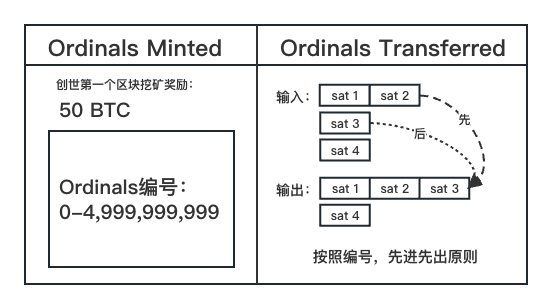
Each satoshi (contained within a UTXO) is numbered in the order they were minted with an Ordinal number. During transfers, they follow a first-in-first-out rule, moving from transaction inputs to outputs.
- Inscriptions are the actual content of Ordinals NFTs - images, text, video, or any other arbitrary data that users associate with NFTs.
Fungible tokens are interchangeable. For example, you cannot distinguish between two different bitcoins, just as you cannot distinguish one dollar from another. The key innovation of Ordinal NFTs is that they provide a system for numbering each satoshi. The result: every satoshi on the Bitcoin blockchain has a unique ID.
In Ordinal theory, individual satoshis are numbered in the order they were mined. The first serial number is the first satoshi minted in the Genesis block, traceable back to 2008. When a bitcoin is transferred, the ordering is preserved through a first-in-first-out system based on transaction order.
Metadata
On non-Bitcoin blockchains, metadata is an optional component - arbitrary data that can be attached to a non-fungible token. It is used to represent and display a wide range of art, in-game assets, profile pictures, financial assets, and more, all of which have become synonymous with the term "NFT."
Inscriptions as Metadata
Ordinal NFTs do not have a designated metadata field (tokenURI) like non-Bitcoin NFTs. Instead, Ordinals NFT metadata is stored in the witness data of a transaction.
To inscribe data onto a specific bitcoin and create an ordinal NFT, users must send some satoshis as a separate Bitcoin transaction to a Taproot-compatible wallet and include the desired metadata as part of the transaction. They must also pay attention to transaction ordering to ensure the desired satoshis are not used as network fees. Tools that automate this process help eliminate these risks and make the process easier for non-technical users.
How Are Bitcoin Ordinals Different from NFTs?
The key difference between Bitcoin Ordinals and more standard types of NFTs is their fungibility. Because the Bitcoin protocol does not formally recognize Ordinal theory, an Ordinal can be either fungible or non-fungible. It entirely depends on who owns the Ordinal and whether they wish to preserve that individual satoshi.
For example, if a Bitcoin user does not recognize or care about an Ordinal or the data attached to it, it can simply be used like any other Bitcoin. In this case, Ordinals are fungible - they can be used to pay network fees or sent as payment, with the arbitrary data still attached. This is not the case with Ethereum NFTs. Ethereum NFTs are fundamentally different from fungible Ethereum tokens, and it is impossible to confuse fungible tokens with NFTs because the Ethereum network treats each token type differently.
Related Concepts
-
What is NFT?
-
BRC-20
Reference:
https://academy.binance.com/zh/articles/what-are-ordinals-an-overview-of-bitcoin-nfts?&utm_campaign=web_share_copy