Bitcoin Cash
Introduction
Bitcoin Cash (BCH) is a cryptocurrency that hard-forked from Bitcoin in 2017, born as a result of the community's scaling debate.
BCH Origin History
Since Bitcoin's birth on January 3, 2009, it grew from being popular only among tech enthusiasts to gradually entering the public eye, with an ever-expanding user base and increasing transaction volume. Since each block in the Bitcoin system is limited to 1MB, the number of transactions that can be stored in each block is very limited, thus restricting overall transaction throughput. The Bitcoin network began experiencing congestion, excessively high fees, and transactions waiting a long time to be processed. At the time, Bitcoin could process approximately 4-7 transactions per second, which is clearly insufficient compared to Alipay, PayPal, and other services. Low transaction efficiency made BTC unable to serve as a cash payment system.
In 2015, voices calling for scaling emerged in the Bitcoin community. Miners supported increasing Bitcoin's block size to increase transaction capacity, while small-block advocates represented by the Core development team argued that this could not fundamentally solve the problem and instead advocated using Segregated Witness and the Lightning Network to alleviate Bitcoin's congestion. The dynamics between miners, development groups, and users were relatively chaotic, and the Bitcoin community debated the scaling issue for three years. Community conflicts gradually became irreconcilable, and calls for a hard fork grew louder.
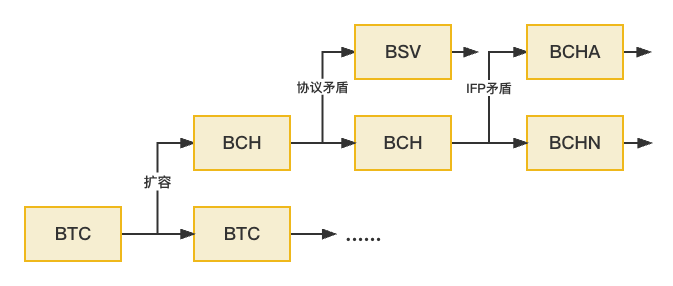
Finally, on August 1, 2017, miners executed a hard fork at block height 478,558. Six hours later, the ViaBTC mining pool successfully mined the first Bitcoin Cash (BCH) block (nr 478,559), splitting the Bitcoin community in two. Bitcoin Cash inherited Bitcoin's transaction data but removed Segregated Witness, upgrading the block size limit to 8MB (later upgraded to 32MB), committed to solving Bitcoin's block congestion and high fee problems through on-chain scaling. BCH was subsequently distributed to Bitcoin holders at a 1:1 ratio. To refine the system, BCH underwent hard forks every six months. After several upgrades, the system gradually stabilized, with its market cap entering the top ten crypto assets.
BCH Development
In April 2018, the BCH community published a mid-term development roadmap announcing plans for technical upgrades and improvements to BCH. This mainly included two aspects: one was scaling, increasing block size to 32MB; the other was adding or reactivating several Bitcoin script opcodes to give the BCH network smart contract capabilities similar to Ethereum, thereby expanding BCH's applications.
However, Australian scientist Craig Wright (CW), who claimed to be Satoshi Nakamoto, explicitly opposed this plan. He believed that Bitcoin established a solid foundation in version 0.1, and that BCH only needed to expand capacity and lock the protocol, declaring that he would "completely lock down the Bitcoin base protocol and scale to 128MB." He established a project called Nchain and on August 16, 2018, created the BSV node client, threatening to implement a fork coin called Bitcoin Satoshi Vision (BSV) on the BCH protocol, with the goal of restoring Bitcoin's original protocol.
After several rounds of verbal sparring between the two camps, tensions once again reached a peak and became irreconcilable. On November 16, 2018, BCH officially hard-forked into BCHABC and BCHSV. This fork led to a consensus split and a crash in major cryptocurrency prices. Subsequently, BSV performed a "hard fork" on July 24, 2019, increasing block size from 128MB to 2GB, higher than any other blockchain project. In the days following the upgrade, the BSV chain successfully mined a 256MB block, setting a world record for the largest block mined by a public chain. From then on, the Bitcoin camp was divided into three: BTC, BCH, and BSV.
BCH Forks Again
On November 15, 2020, BCH officially hard-forked at block height 661,648, splitting into Bitcoin ABC (BCHA) and Bitcoin Cash Node (BCHN). The reason for this fork was that BCH's main development team, BCH ABC, insisted on introducing the "Infrastructure Funding Plan" (IFP) in the November upgrade. Initiated by some large miners, it was primarily intended to solve the funding problems facing the development team, requiring that 8% of BCH block rewards be allocated to an infrastructure development fund as key development funding for BCH. However, this was strongly opposed by the majority of miners and the community. This BCH fork was an interest dispute between miners and developers.
Developer compensation is a common issue across blockchain projects. Miners are clear participants and protectors of the blockchain ecosystem who can earn system token rewards. Developers, on the other hand, bear the work of upgrading and improving the entire public chain but cannot directly earn income from the system. Currently, developers generally receive compensation through community donations or commercial investment.
The commercial investment model risks shareholders using equity to gain control over the development team. The BCHABC team rejected commercial investment to maintain their independence, but the limited funding obtainable through community donations meant the development funding issue remained a challenge for BCH's future development.
BCHABC Camp: Insisted on advancing the donation plan and announced on February 18, 2020, that the relevant code had been added to the ABC version 0.21.0 client. They also emphasized that this did not mean miners would lose 8% of their income - due to difficulty adjustments, mining income would only decrease by 0.2%.
BCHN Camp: Early BCH developer Freetrader led the creation of a full node called BCH Node, developing and releasing the IFP-free BCHN 22.0 node version, promising to maintain the BCH protocol without forcing miners to pay a "miner tax."
Looking at the block production data from the last week before the fork, 84.2% of blocks were mined by the BCHN community, while 0% were mined by BCHA. The BCHN camp held an absolute advantage in hash power over the BCHABC camp.
Ultimately, on November 15, 2020, BCH officially hard-forked into BCHA and BCHN. BCHN won with an overwhelming advantage and carried on the BCH legacy.
Reference: https://www.defidaonews.com/article/669122